>>> Project Highlights
Snippets
This page presents some snippets of recent projects. See the Research page for a broader overview of my research activities.
Truck Ingress and Egress
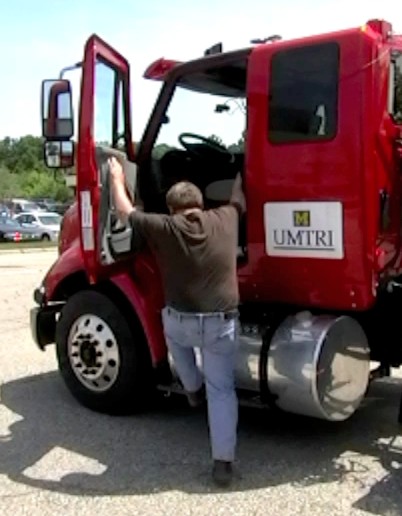
Truck driving is among the most dangerous occupations in the U.S. Crashes are not the main cause of injury, though: Most occupational injuries to truck drivers are due to slips and falls. With support from at R01 grant from the National Institute for Occupational Safety and Health, we are conducting a field and laboratory study of truck driver ingress and egress. Our work uses biomechanical analysis techniques to quantify ingress/egress behaviors. We have gathered field data on entry and exit techniques drivers use, interviewed drivers on their experiences, and conducted a detailed laboratory study. Using an optical motion capture system and an instrumented cab mockup, we recorded driver's movements and the forces they exerted with a wide range of step and handhold configurations.
The outcomes of this research will include new design guidelines for truck ingress/egress systems (steps and handholds), new biomechanical analysis methodologies that can be used to assess candidate systems, and a better understanding of the factors that influence the risk to drivers of both acute and chronic injury.
Advanced Anthropometry for Child Crash Dummy Design
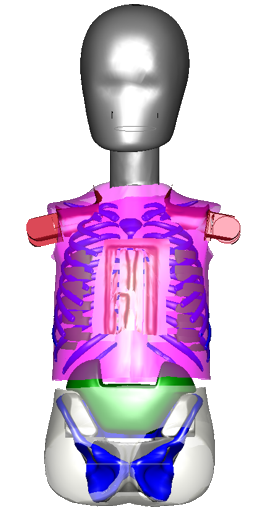
The performance of belt-positioning booster seats used by children who are too small to achieve good belt fit with vehicle belts alone, and no longer riding in harness restraints, is assessed in U.S. regulatory tests using Hybrid-III dummies. Unfortunately, these dummies interact with belt restraints in unrealistic ways. The lap, shoulder, and chest areas where the belt contacts the dummy are of particular concern, because the dummy geometry in these areas is substantial different from the skeletal anatomy of similar-size children. We are working on developing improved components for the dummies, starting with the Hybrid-III six-year-old. We have developed new methods for extracting and analyzing the shapes of anatomical structures from medical imaging data. We've used these methods to create a statistical model of the child pelvis, thorax, and shoulder based on data from over 80 children from ages 4 to 12. The analysis allows us to create skeletal models for children in that age range as a function of age, stature, body weight, or other variables. We've used these model to create a geometric target for the 6YO pelvis and thorax. This figure compares the skeletal gometry of the Hybrid-III 6YO to the targets.
Optimizing Head Restraint Geometry
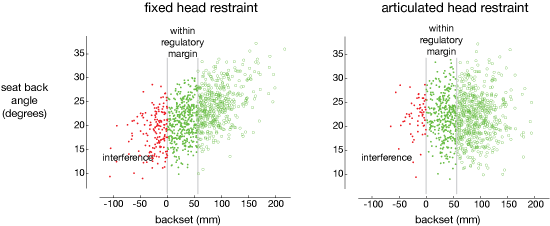
The National Highway Traffic Safety Administration (NHTSA) has amended Federal Motor Vehicle Safety Standard (FMVSS) 202 to require higher and more-forward head restraints (sometimes called head rests, but primarily intended to protect occupant's necks in rear collisions). The new regulation, called FMVSS 202a, requires that head restraints lie within 55 mm of a Head Restraint Measurement Device representing a midsize-male head shape when measured at a seat back angle of 25 degrees. When this rule was proposed, my colleagues and I published a report showing that most drivers sit with more-upright seatback angles. We concluded that designing to the 55-mm "backset" would cause the head restraint to interfere with the preferred head locations of a substantial number of drivers. This prediction has since been substantiated by other research and field reports from vehicles built to the new standard. Recently, my colleague Prof. Matt Parkinson, who heads the OPEN Design Laboratory at Pensylvania State University, conducted a simulation study of an alternative seat back design that optimizes the head restraint position across seat back angles. This approach reduces the likelihood of interference with the head restraint for smaller-stature drivers while ensuring that taller drivers, who tend to select more-reclined seat back angles, are equally well protected. More...
©2024 Matthew P. Reed and The University of Michigan