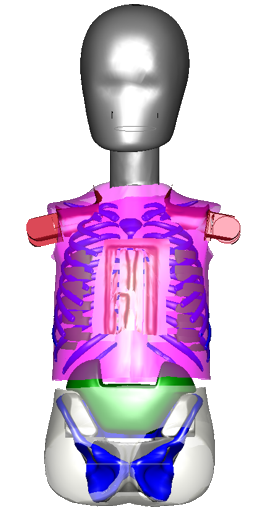
The performance of belt-positioning booster seats used by children who are too small to achieve good belt fit with vehicle belts alone, and no longer riding in harness restraints, is assessed in U.S. regulatory tests using Hybrid-III dummies. Unfortunately, these dummies interact with belt restraints in unrealistic ways. The lap, shoulder, and chest areas where the belt contacts the dummy are of particular concern, because the dummy geometry in these areas is substantial different from the skeletal anatomy of similar-size children. We are working on developing improved components for the dummies, starting with the Hybrid-III six-year-old. We have developed new methods for extracting and analyzing the shapes of anatomical structures from medical imaging data. We've used these methods to create a statistical model of the child pelvis, thorax, and shoulder based on data from over 80 children from ages 4 to 12. The analysis allows us to create skeletal models for children in that age range as a function of age, stature, body weight, or other variables. We've used these model to create a geometric target for the 6YO pelvis and thorax. This figure compares the skeletal gometry of the Hybrid-III 6YO to the targets.
January 2008
Advanced Anthropometry for Child Crash Dummy Design