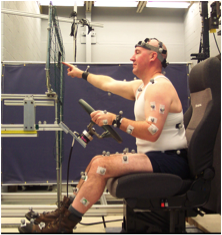
The design of truck and off-highway equipment cabs (agriculture, construction, mining, and forestry) is becoming more complex due to the increase in the use of electronic controls and displays. In most cases, the new equipment is added to the customary manual controls, creating a need to optimize the layout for all tasks.
We conducted a study of seated operators to quantify reach and force-exertion capability as a function of task location relative to the driver and package. Licensed truck drivers reached for push-button targets located throughout the workspace, providing subjective ratings of difficulty for each target. The subjects also exerted force on a handle located in 13 discrete positions spanning the range of typical hand control locations.
The drivers also operated accelerator, brake, and clutch pedals, using both normal motion speed and "as fast as possible", simulating emergency operation. An optical motion-capture system was used to record whole-body kinematics.
The data from this study are being used to develop new design tools for assessing and laying out truck and heavy equipment cabs.