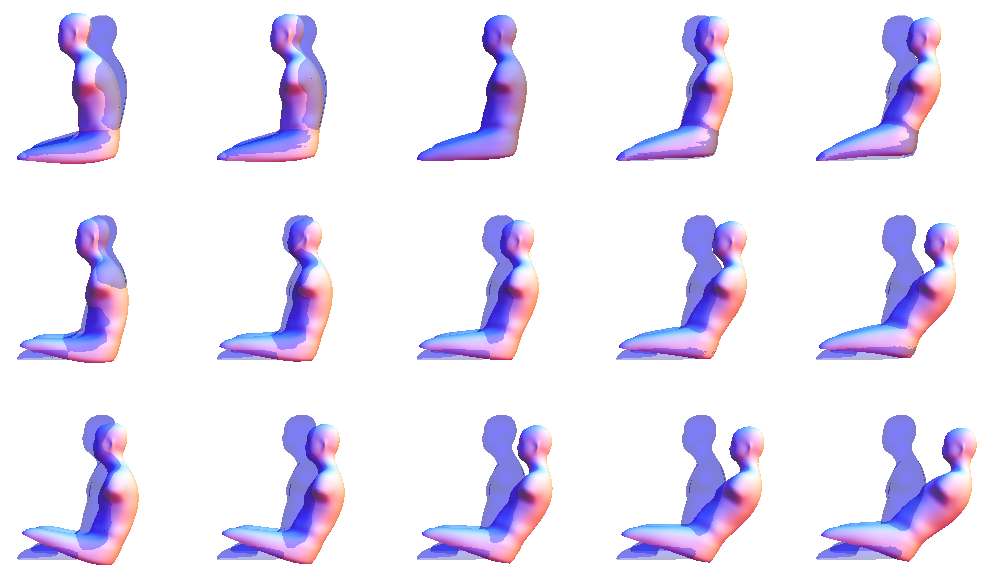
Three-dimensional anthropometry is a part of many of my current research projects. Using data from UMTRI's whole-body laser scanner, medical imaging data, or studies conducted elsewhere, we create statistical models of anatomical shapes. These models are used for a wide variety of design and analysis purposes, from creating anthropometric specifications for crash dummies to virtual seat assessments. One challenge in using 3D scan data is that each scan represents a single posture. For general applications, it's necessary to be able to alter the posture of the scan. This figure shows a statistical model of the seated torso that encompasses both anthropometric and postural variability. A single relaxed seated scan from each of 712 men and women was morphed to 15 different postures using a skeletal linkage. The resulting external body shapes were analyzed using a principal component analysis/regression (PCAR) approach to produce the model demonstrated in the figure. The model provides an efficient way of representing a wide range of seated body shapes driven by both structural anthropometry and posture.The model has applications from seat and chair design to the development of parametric finite-element models for crash safety analysis.
March 2011
3D Body Shape and Posture Modeling from Body Scan Data