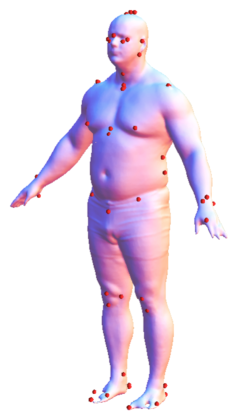
Locating body surface landmarks on whole-body scan data is usually a time-consuming manual process. Manual digitizing is the "gold standard", producing higher accuracy and precision than automated methods, but for some applications a rapid, fully automated procedure is desireable, even if accuracy is lower. I presented a brief paper at the IEA conference in Melbourne, Australia, this month examining the precision of a purely statistical method for predicting landmark and joint locations. The method is based on a statistical body shape model that incorporates landmarks and joints. The results showed that the predictions for torso joints are surprisingly precise when scan data is fitted using a rapid optimization process. The most important near-term application is the estimation of a kinematic linkage for avatars created from Kinect scan data.
May 2014
International Ergonomics Association Conference: Predicting Body Surface Landmarks