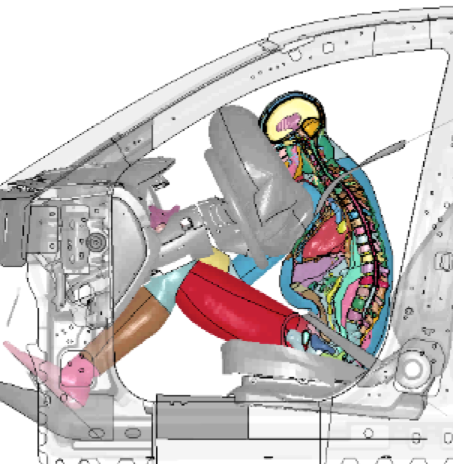
I presented a short communication at the 2014 IRCOBI conference in Berlin this month addressing driver knee locations. In modern vehicles, the underside of the instrument panel is designed to absorb energy in frontal impacts by exerting controlled force on the driver's knees. The knee bolster is an important component of the restraint system, sharing load with the steering wheel airbag and three-point belt. In recent work, we showed that the lap portion of the belt fits considerably more loosely for most people than for crash dummies. A loose belt means that the occupant will translate further forward before belt force builds up, potentially changing the load sharing between the belt and knee bolster. The starting knee location at the time of the crash is one critical determinant of load sharing. We used data from 100 men and women with a wide range of body size who sat in a laboratory vehicle mockup in 9 different vehicle configurations spanning the range from sports cars to SUVs. We used regression analysis to model the location of the forward-most margin of the patella (kneecap) as a function of vehicle and driver variables. As expected, the vehicle configuration had a strong effect, but we also found that taller drivers' knees are more rearward, on average. These results are useful for understanding the distribution of drivers' knee locations in any particular vehicle and could be used to conduct parametric studies of load sharing for a range of frontal impact conditions.
November 2014
Knee Locations in Driving Postures