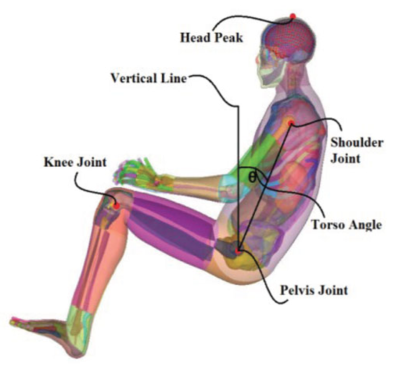
Analyses of crash data in the field have shown that obese occupants are at higher risk in frontal crashes than occupants of normal weight. Improving protection for obese occupants requires an understanding of how these occupants interact with restraint systems. At the 2015 ESV Conferencein Gothenberg, Sweden, my colleague Jingwen Hu presented a simulation study aimed at understanding how obese occupants interact with belts in frontal impact. This work is based on a new paradigm in parametric human modeling that allows rapid, accurate morphing of complex finite element models to represent individuals with a wide range of size and shape. This study validated a set of obese occupant models using post-mortem human subject data from testing conducted at the University of Virginia.
April 2015
Effects of Obesity on Crash Protection