The Biosciences Group had a big presence at the SAE Congress in Detroit this month. We presented research on a broad range of topics from seat shape modeling to restraint system optimization for military vehicles. Here are some highlights:
**Reed, M.P. and Ebert, S.M. (2016). Evaluation of the seat index point tool for military seats. SAE Technical Paper 2016-01-0309. SAE International Journal of Commercial Vehicles. **
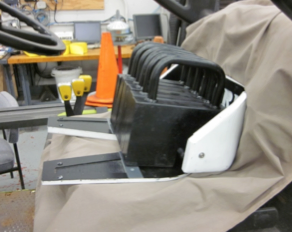
In the design of on-highway vehicles, the SAE J826 H-point machine is used globally to establish reference points and angles to define the seat position and orientation. However, the H-point machine doesn't work very well in many military vehicle seats. In this paper,we compared the performance of the ISO 5353 seat index point tool (SIPT) to the H-point machine and found that not only is it more stable, but it gives comparable results in many situations. Consequently we recommend that the U.S. Army immediately adopt the SIPT as the standard for measuring ground vehicle seats whenever the H-point machine cannot be used or is not available.
Drignei, D., Mourelatos, Z., Kosova, E., Hu, J., Reed, M.P., Rupp, J.D., Gruber, R., and Scherer, R. (2016). Uncertainty assessment in restraint system optimization for occupants of tactical vehicles. SAE Technical Paper 2016-01-0316. SAE International Journal of Materials and Manufacturing, 9: 436-443
We are in the final stages of a large-scale project developing optimized restraint systems for a Humvee-like vehicle to protect its occupants in frontal-crash and rollover events. We conducted sled testing of a variety of restraints with fully equipped soldiers, then performed a wide-ranging simulation study to identify optimal restraints, including airbags for frontal crash protection. One challenge in restraint system optimization is that the complexity of the computational models for simulating crashes means that we can't run as many physical or computational tests as we would like. This paper explores a method for estimating the uncertainy in outcomes given a small number of test results.
Hwang, E., Hallman, J., Klein, K., Rupp, J.D Reed, M.P. and Hu, J. (2016). Rapid development of diverse human body models for crash simulations through mesh morphing. SAE Technical Paper 2016-01-1491. SAE International, Warrendale, PA.
Our postdoc Eunjoo Hwang presented some of her work on parametric modeling of vehicle occupants. The work reported here was actually completed about 18 months ago and represented the first project we're aware of to successfully morph a high-fidelity human body model (THUMS4, in this case) to a wide range of body sizes. With leadership from Dr. Jingwen Hu, we have extended this broadly, generating over 100 anthropometricallly distinct versions of THUMS4.
**Jones, M.L., Ebert, S.M., and Reed, M.P. (2016). A Pilot Study of Occupant Accommodation and seat belt fit for law enforcement officers. SAE Technical Paper 2016-01-1504. SAE International, Warrendale, PA. **
My colleague Dr. Monica Jones presented some interesting pilot work she conducted assessing the geometric fit of law-enforcement officers (LEO) in vehicles with a focus on seats and restraint systems. Car crashes are a leading cause of death for LEO in the U.S., with more officers killed in vehicles than by guns. Some officers report that they do not wear their safety belts because they do not fit well when they're wearing their duty belts, and lower-back and other musculoskeletal ailments due to poor vehicle ergonomics are a leading cause of lost work time for officers. In this study, Monica used 3D laser scanning to document the mismatch between LEO and their seats and vehicles. More work is needed in this area to improve vehicle designs for law enforcement.
Park, J., Ebert, S.M., Kim, K.H., Jones, M.L., Park, B-K, and Reed, M.P. (2016). Development of an automatic seat-dimension extraction system. SAE Technical Paper 2016-01-1429. SAE International, Warrendale, PA. Dr. Jangwoon Park, a post-doc in our lab, developed a novel automated software system for extracting seat dimensions. In the auto industry, seat benchmarking is a slow process. Extracting the dimensions defined by SAE J2732 can take hours. Dr. Park's system can compute dimensions in minutes from a 3D scan of the seat, assuming H-point data are available. We are exploring the potential of combining this system with the statistical shape modeling methodology described below to create a new, quantitative system for evaluating vehicle seating.
Kim, K.H., Ebert, S.M., and Reed, M.P. (2016). Statistical modeling of automotive seat shapes. SAE Technical Paper 2016-01-1436. SAE International, Warrendale, PA.
My colleague Dr. Han Kim developed an interesting approach to analyzing seat shapes. Observing the organic contours typical of modern auto seats, he applied the same methods we've been using in recent years for modeling human body shape. He developed a semi-automated method for fitting a template to each seat so that the contours are amenable to a statistical analysis using principal component analysis and regression. The resulting parameterization can be used for a host of interesting applications, including seat shape clustering, interpolating among seats, finding the "nearest neighbor" of a seat, and designing completely new seat shapes. The potential of this new tool will begin to be realized after we are able to add perhaps 100 more seats to the database.