I joined my UMTRI colleagues Dr. Monica Jones and Dr. Daniel Park at the Digital Human Modeling Conference in Montreal. Our hosts at ÉTS did a terrific job organizing the conference. We presented work focused on three-dimensional anthropometry and computational simulation of vehicle occupants
Jones, M.L.H., Ebert, S.M., Hu, J., Park, B-K.D., and Reed, M.P. (2016). Quantifying body shape differences between supine and standing postures for adults with high body mass index.Proc. 4th International Digital Human Modeling Conference. Montreal, Canada
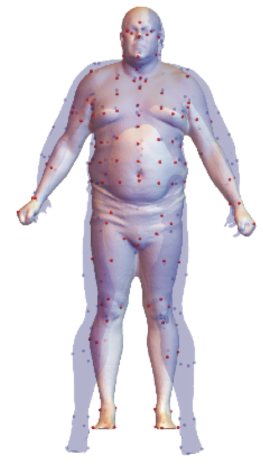
Dr. Jones presented a pilot study of the body shape of men and women with high body weight. People with body mass index >40 kg/m2 are almost completely absent from previous body scan study. Yet, such adults are about 5% of the U.S. adult population, and their attributes are critical to set design targets for many products, including vehicle seats and medical equipment. In this study, we also compared supine and standing postures. The goal is to create a linkage
Reed, M.P., Park, B-K. D., and Corner, B.D. (2016). Predicting seated body shape from standing body shape. Proc. 4th International Digital Human Modeling Conference. Montreal, Canada.
As part of a collaborative project with the U.S. Army, we have been exploring many issues related to the measurement and modeling of body shapes. Most scan datasets have a large number of subjects in small number of postures, none of which are functional postures useful for vehicle and seat designs. However, our UMTRI studies typically measure participants in up to 25 postures, including supported seated postures. To make better use of other studies, we developed a statistical model that very accurately predicts seated body shape from a standing scan. We demonstrated the method with civilian female models, but we will be exending this to the male military population.
Park, B-K.D., Corner, B.D., Kearney, M., and Reed, M.P. (2016). Estimating human body characteristics under clothing using a statistical body shape model. Proc. 4th International Digital Human Modeling Conference. Montreal, Canada.
Most body scan surveys measure people minimally clad so that the data best characterize the surface shape. However, in many practical situations it is not feasible to measure people without clothing. Hence, methods for estimating body shape under clothing have great potential utility for building subject-specific avatars. My colleague Daniel Park developed a novel method for rapidly fitting a statistical body shape model to a clothed figure. He demonstrated that the method was surprisingly effective even with soldiers wearing body armor and gear.
Hu, J., Fanta, A., Neal, M.O., Reed, M.P., and Wang, J-T. (2016). Vehicle crash simulations with morphed GHBMC human models of different stature, BMI, and age. Proc. 4th International Digital Human Modeling Conference. Montreal, Canada.
Mark Neal from General Motors presented an overview of a collaboration between UMTRI and GM that is part of our effort to dramatically increase the utility of computational human models for restraint system optimization. Jingwen Hu has led the efforts at UMTRI to develop methods to rapidly morph complex FE models (2M elements) to any arbitrary body size and shape. In this project, the template model is the GHBMC midsize male. The 100 models developed in through this study extend the population represented by that single model through more than 90% of the U.S. adult population based on stature, age, and BMI.