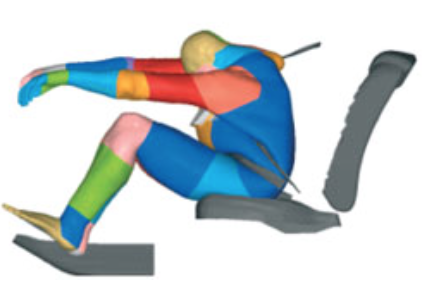
In early October an had the opportunity to visit Chalmers University and SAFER in Gothenburg, Sweden to participate in a dissertation defense. While there I gave a talk on our recent progress on parametric human body modeling. The abstract:
People Are Not Dummies: Modeling Human Variability for Vehicle Restraint System Optimization
Over the past 50 years, crash test dummies (also known as anthropomorphic test devices, or ATDs) have been critical tools for advancing vehicle occupant protection. ATDs allow vehicle manufacturers to design their seat belts, airbags, and other components so that they protect vehicle occupants in a wide range of crash scenarios. However, ATDs are only rough approximations of humans: they have unrealistic body shapes and the need for durability is sometimes achieved at the expense of realism.
In recent years, improvements in computational power and modeling techniques have enabled the creation of highly detailed computer models of human anatomy that can be used to augment ATDs in vehicle design. Currently, most computational models represent people who are the same size as the physical crash test dummies, but our research group has developed methods that allow the existing models to be rapidly morphed to represent a wide range of body sizes and shapes. I'll discuss the rich data we have gathered to characterize the occupant population, the methods and outcomes of model morphing, and the opportunities that we now have to improve protection for the full range of vehicle occupants.