The Biosciences Group was well represented at the SAE Congress this month. My colleagues presented three papers on a range of topics.
** Jones, M.L.H., Park, J., Ebert, S., Kim, K.H., and Reed, M.P. (2017). Effects of Seat and Sitter Dimensions on Pressure Distribution in Automotive Seats. SAE Technical Paper 2017-01-1390. **
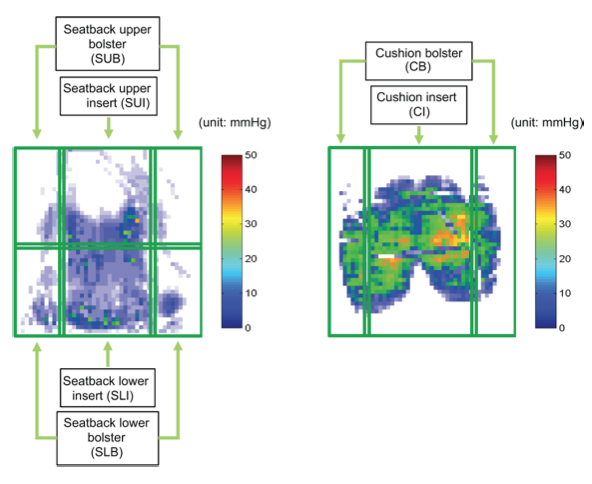
My colleague Dr. Monica Jones presented work investigating the associations between sitter and seat characteristics and the pressure distribution at the seat-sitter interface. A study was conducted using 12 production driver seats from passenger vehicles and light trucks. Thirty-eight men and women sat in each seat in a vehicle mockup and seat surface pressure distribution was measured on the seatback and cushion. Anthropometric dimensions were recorded for each participant and standardized dimensions based on SAE J2732 were acquired for each test seat. Regression models were effective in predicting characteristics of pressure distribution from the anthropometric variables and SAE J2732 dimensions.
**Park, B-K.D. and Reed, M.P. (2017). Characterizing Vehicle Occupant Body Dimensions and Postures Using a Statistical Body Shape Model. SAE Technical Paper 2017-01-0497. **
My colleagueDr. Daniel Park presented a novel method for quantifying vehicle occupant postures and body shapes. The methodology was demonstrated using children and a single Microsoft Kinect sensor. The challenge posed by the noisy and incomplete data was addressed by fitting the data using a statistical body shape model (SBSM). The SBSM used in this work was developed using laser scan data gathered from 147 children with stature ranging from 100 to 160 cm and BMI from 12 to 27 kg/m2 in various sitting postures. A principal component (PC) analysis was conducted based on these scans along with the manually-measured body landmarks, and 100 PC scores were retained to account for 99% of variance in the body shape and sitting postures. A PC-based fast fitting method was applied to estimate the occupant characteristics by fitting the SBSM to an incomplete depth image of a subject. The results demonstrate that a fast, inexpensive system can be used to produce useful estimates of occupant characteristics that could be applied to improve personalization of component adjustments, restraint systems, and infotainment systems.
**Hu, J., Orton, N., Gruber, R., Hoover, R., Tribbett, K., Rupp, J.D., Clark, D., Scherer, R., and Reed, M.P. (2017). Development of A New Dynamic Rollover Test Methodology for Heavy Vehicles. SAE Technical Paper 2017-01-1457. **
The SAE J2114 dolly rollover test is the most widely used vehicle rollover test procedure. However, it requires the test vehicle to be seated on a dolly with a 23° initial angle, which makes it difficult to test a vehicle over 5,000 kg without a dolly design change, and repeatability is often a concern. My colleagueDr. Jingwen Hu presented a new dynamic rollover test methodology that can be used for evaluating crashworthiness and occupant protection without requiring an initial vehicle angle. A custom cart was designed to carry the test vehicle laterally down a track. The cart incorporates two ramps under the testing vehicle's trailing-side tires. In a test, the cart with the vehicle travels at the desired test speed and is stopped by a track-mounted curb. While the cart is being stopped by two honeycomb blocks, the vehicle slides laterally from the cart with the far-side wheels sliding up the ramps, which generates the desired lateral roll rate. The vehicle near-side wheels slide onto a high-friction surface, which generates an additional strong roll moment around the vehicle center of gravity. Three physical tests using three armored military vehicles were conducted using the procedure. All tests resulted in the desired 5 to 8 quarter-turns of the vehicle, and the instrumented tests showed repeatable initial roll rates. The tests demonstrated that the newly-designed rollover procedure is suitable for vehicles that are generally too large/heavy for other dynamic rollover methods, and may also be useful for lighter vehicles when a well-controlled, directly lateral roll is desired.