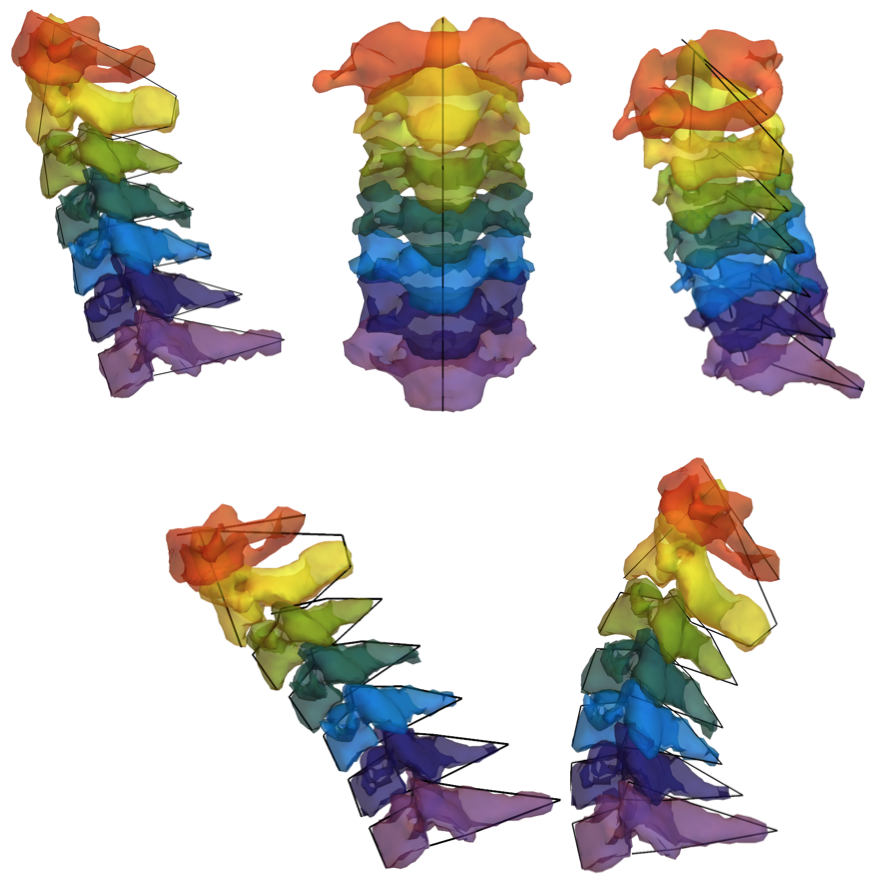
The cervical spine is of considerable interest in biomechanics research due to its complexity and its importance as a site of both low-severity and high-severity injury (e.g., whiplash-associated disorders and fractures with spinal cord injury). My colleague Dr. Monica Jones and I recently published a technical report describing new two- and three-dimensional parametric models of cervical spine geometry and posture. The data for the 2d model were drawn from a Snyder et al. x-ray study conducted at UMTRI in the 1970s. Using the same methods we've previously applied to model body shape, we created a parametric model that generates sagittal spine geometry as a function of sex, stature, age, and head-to-thorax posture. This is the only parametric model of its kind for unsupported head postures typical of seated environments, such as vehicles. In addition, we linked this 2d model to 3d geometry provided by collaborators at Johns Hopkins University Applied Physics Lab (APL). Using 3D spine geometry data extracted by APL from medical imaging (CT) studies, we created a parametric model that predicts 3d bone geometry from 2d shape. One unexpected observation is that lateral dimensions of cervical vertebrae are essentially uncorrelated with sagittal dimensions. The resulting 3d model can be used as input for finite-element models used to examine the influence of posture and spine shape on injury risk in a wide range of exposures. This model is implemented in Python and is freely available for use -- just contact me to get it.
July 2017
Model of Cervical Spine Geometry