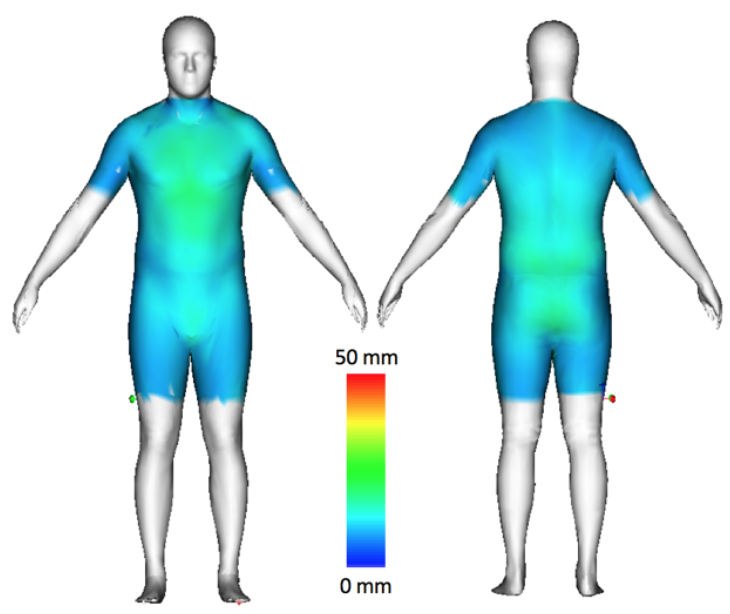
My colleague Dr. Daniel Park and I recently completed a research project for the U.S. Army that tackled an array of cutting-edge problems relating to human body measurement and modeling. The report on this work is now available online. From the abstract: "Two metrics were devised for comparing two body shapes represented by surface meshes. The distance from the nodes of one mesh to the polygonal surface of another was defined as mesh error. Six torso dimensions computed between mesh nodes that are analogous to standard anthropometric measures were compared to compute mesh error. Analyses were performed using three datasets: 236 male Soldiers, 200 Air Crew, and 73 civilian women. Statistical body shape models (SBSM) were developed using methods developed and adapted in previous UMTRI research. A standardized template was fit to each scan to enable the analysis. Mesh error was found to diminish smoothly with the number of PCs used for reconstruction, with minimal improvement after 100 PCs. When conducting regression predictions, retaining more than 80 PCs provided minimal improvement in mesh or dimension error metrics. A simulation study demonstrated that improvements in regression model performance when using more than 50 subjects were small. Errors in predicting Air Crew torso mesh dimensions using 10 standard anthropometric variables averaged less than 10 mm. A novel method was developed to predict seated body shape from standing body shape, and a new inscribed fitting method enabled generation of accurate avatars from scans of individuals wearing clothing and gear. A pilot test demonstrated the potential for scanning prone individuals using a transparent table to obtain good coverage." Whew! Lots of good stuff in there. Contact me if you'd like details or would like to use these models or methods.
July 2017
Technical Issues in Statistical Modeling of Body Shape