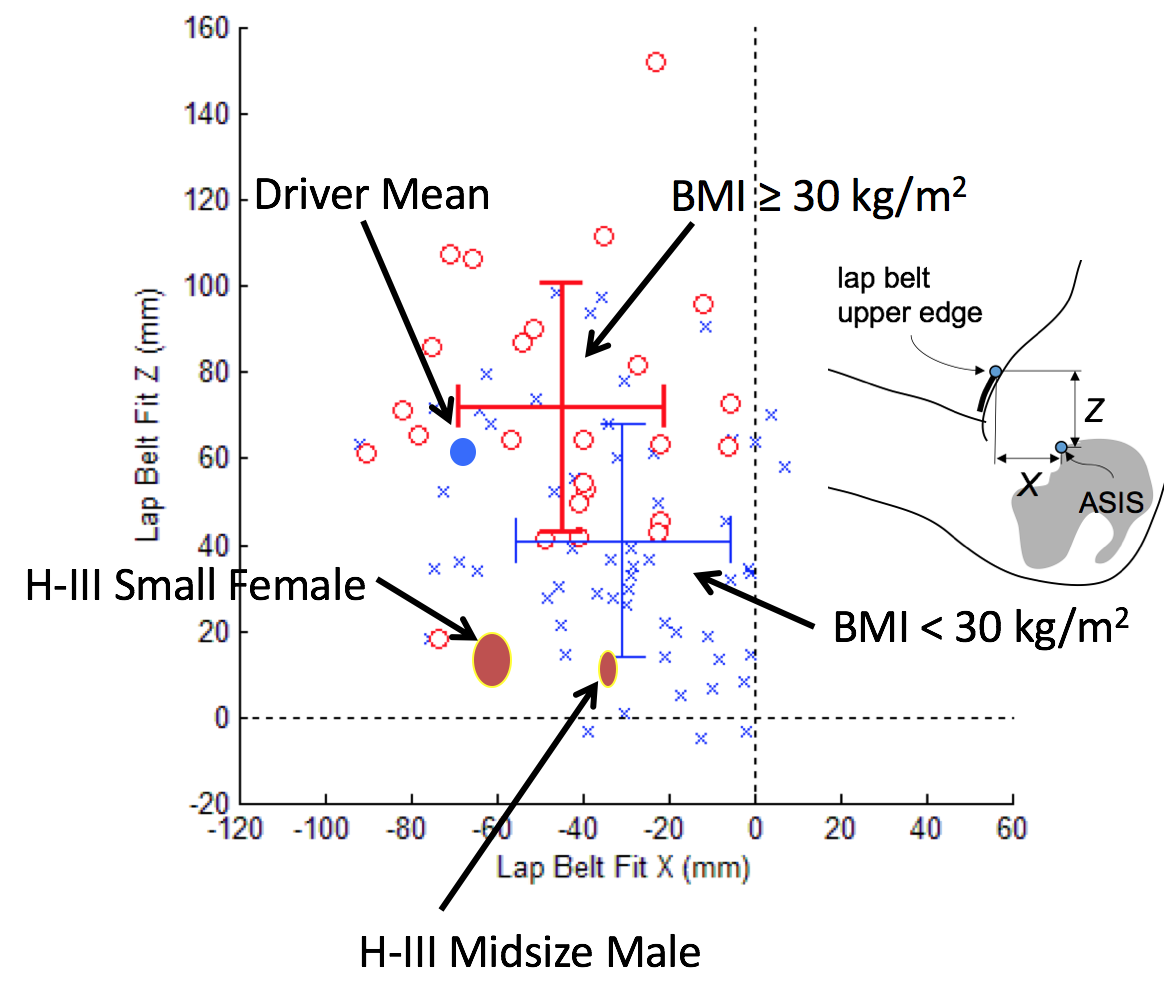
I attended the annual meeting of the Association for the Advancement of Automotive Medicine in Las Vegas, NV this month. I presented a paper comparing the belt fit obtained by rear-seat passengers with the belt fit measured on Hybrid-III ATDs using standardized installation procedures. [This paper has been accepted for publication in a special issue of Traffic Injury Prevention.] On average, the belt fit for the ATDs was much lower and more advantageous, relative to the pelvis. The shoulder belt also routed much closer to the centerline for the ATDs. These differences in belt fit may have important implications for the design of restraint systems. The lower placement of the lap portion of the belt likely means that the ATDs are less likely to submarine than the ATDs. This in turn may result in manufacturers choosing flatter belt angles than would be optimal for human occupants. Similarly, the more-centered shoulder belt placement may result in an underestimate of the chest loading that would result in a forward crash, diminishing the importance of load limiting. Further research with parametric human body models is needed to evaluate these effects.
October 2017
Rear-Seat Passenger Belt Fit