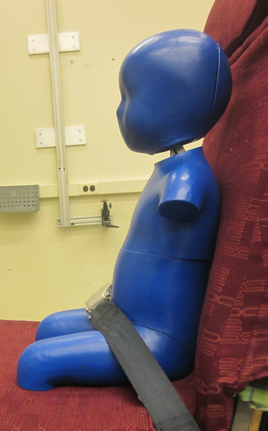
Our group was well represented at the annual European meeting of theInternational Research Council on the Biomechanics of Injury. We presented two full papers and one short communication describing recent work.
Reed, M.P. and Boyle, K.J. (2017). Development of a manikin representing a two-year-old child for belt-fit measurement. Proc. 2017 IRCOBI Conference. Antwerp, Belgium.
The seats in commercial aircraft in the US are required to provide appropriate lap belt fit for all passengers ages 24 months and older. However, no belt fit procedure or measurement device is specified. This paper describes an internally funded effort to develop a belt-fit test device representing a typical two-year-old child. The external shape is based on output from a statistical model of toddler body shape. The external surfaces were created using 3d printing and mounted to an internal armature that includes hip joints and an articulate four-bar neck. The next step is to validate the belt fit measures obtained using this manikin using measurements from children. As far as we are aware, this is the first belt fit device to be created using 3d printing, as well as the first to be created using a statistical body shape model.
Jones, M.L.H., Ebert, S.M., Hu, J., and Reed, M.P. (2017). Effects of high levels of obesity on lap and shoulder belt paths. Proc. 2017 IRCOBI Conference. Antwerp, Belgium.
Analyses of crash data indicate that high BMI is associated with a higher risk of thoracic injury in frontal crashes. In previous work, we found only small differences in shoulder belt placement relative to the clavicle associated with obesity, although large effects on lap belt placement were found. In the current paper, we used functional regression techniques to model the effects of driver attributes on the path of the belt relative to the skeleton. As expected, higher BMI is associated with with belt routing farther from the skeleton, but we also found sex differences for both the lap and shoulder belt after holding stature and BMI constant. In general, we find that higher BMI causes the lower torso portion of the belt to route more laterally, which may cause increased risk of rib fractures and liver injuries for drivers. We will use these results to improve the routing of belts in simulations of frontal crashes with high-BMI drivers.
Hu, J., Zhang, K., Fanta, A., Jones, M.L.H, Reed M.P., Neal, M., Wang, J-T., Lin, C-H., and Cao, L. (2017). Stature and body shape effects on driver injury risks in frontal crashes: a parametric human modelling study. Proc. 2017 IRCOBI Conference. Antwerp, Belgium.
My colleague Dr. Jingwen Hu presented results of ongoing work examining the effects of body size, shape, posture, and position on crash outcomes. The parametric modeling paradigm developed in our group allows us to morph high-fidelity finite-element human models to represent any of a wide range of occupant sizes and shapes. In this work, we used validated posture-prediction models to position six human body models: three representing the reference anthropometry of the small-female, midsize-male, and large-male ATDs that are widely used for vehicle safety system assessment, and three models with the same stature but a BMI of 40 kg/m^2 (roughly the 95th percentile for US adults). The results showed very different restraint system interactions across the body size and shape space. BMI was associated with higher injury risk, consistent with the field data, and both short and tall drivers were at higher risk. The results highlighted the possibility of the driver's torso disrupting the deployment of the airbag, reducing its effectiveness. Future studies with a much larger number of body sizes and shapes are underway.