Our group was well represented at the SAE International World Congress this year. Pleasecontact me if you'd like copies of any of these papers.
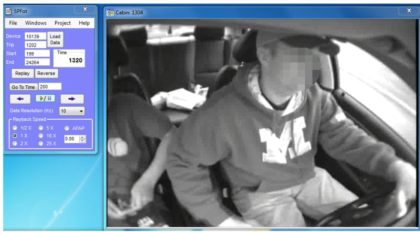
Driver upper-extremity postures and activities were manually coded in 9856 video frames from 165 drivers in 100 vehicles that were instrumented with interior cameras as part of the Connected Vehicle Safety Pilot Model Deployment study. Drivers had left, right, and both hands on the steering wheel in 64%, 46%, and 28%, respectively, of frames in which the hand placements could be determined. The driver’s left elbow was in contact with the door or armrest in 18% of frames, and the driver’s right elbow was contacting the center console armrest in 29% of frames. Men were more likely than women to use both the left and right armrests. Women had approximately the same percentage of armrest use across vehicles, but men’s usage differed widely, suggesting that armrest design may influence whether people of different statures can use the armrests comfortably. Women were more likely to have a phone in their right hands than men, and women were twice as likely as men to be wearing sunglasses during trips taken in daylight hours.
The objective of this study was to optimize the occupant restraint systems for a light tactical vehicle in frontal crashes. A combination of sled testing and computational modeling were performed to find the optimal seatbelt and airbag designs for protecting occupants represented by three size of ATDs and two military gear configurations. This study started with 20 sled frontal crash tests to setup the baseline performance of existing seatbelts, which have been presented previously; followed by parametric computational simulations to find the best combinations of seatbelt and airbag designs for different sizes of ATDs and military gear configurations involving both driver and passengers. Then 12 sled tests were conducted with the simulation-recommended restraint designs. The test results were further used to validate the models. Another series of computational simulations and 4 sled tests were performed to fine-tune the optimal restraint design solutions. The sled tests with the optimized seatbelt and airbag designs provided significant improvement of occupant protection from the baseline tests in terms of the head, neck, chest, and lower extremity injury measures. Using a baseline seatbelt without an airbag, the ATD tended to contact the steering wheel or the instrument panel, or sustained a significant head whipping motion inducing large head and neck injury measures. By adding the airbag and reducing the load limit in the seatbelt, the injury measures were improved significantly. This study demonstrated the benefit of adding a properly designed airbag and advanced seatbelt to improve the occupant protection in frontal crashes under an environment representing a light tactical vehicle.
The interior layout of passenger cars and light trucks is substantially aided by SAE occupant packaging tools, which include the SAE J941 eyellipse, SAE J287 reach curves, and the seating accommodation model in SAE J4004. Most of these tools were developed based on posture and position data from drivers, although an eyellipse and head contour are available for fixed-seat passenger positions. This paper reviews the current SAE occupant packaging tools and related industry practice in the context of current concepts for highly automated vehicles, considering SAE levels 4 and 5. Concepts that have driver controls for occasional use and vehicles with no driver controls are examined. Gaps in the current knowledge and tools are reviewed to establish priorities for research and development of new standards and recommended practices.
Analyzing dynamic postures of vehicle occupants in various situations is valuable for improving occupant accommodation and safety. Accurate tracking of an occupant’s head is of particular importance because the head has a large range of motion, controls gaze, and may require special protection in dynamic events including crashes. Previous vehicle occupant posture studies have primarily used marker-based optical motion capture systems or multiple video cameras for tracking facial features or markers on the head. However, the former approach has limitations for collecting on-road data, and the latter is limited by requiring intensive manual postprocessing to obtain suitable accuracy. This paper presents an automated on-road head tracking method using a single Microsoft Kinect V2 sensor, which uses a time-of-flight measurement principle to obtain a 3D point cloud representing objects in the scene at approximately 30 Hz. Vehicle passenger motions were recorded during hard braking and rapid lane changes. The dynamic head orientation and location data were obtained by fitting a subject-specific 3d head model to the depth data from each frame. Results were validated using a marker-based tracking system based on video images from multiple views. The results showed that the proposed method and system provides efficient and accurate in-vehicle head tracking using a single low-cost depth camera. Extensions of this method have broad applications for study of vehicle occupant dynamics, and with advances in technology may be applicable to routine use in production vehicles.
Motion sickness in road vehicles may become an increasingly important problem as automation transforms drivers into passengers. Motion sickness could be mitigated through control of the vehicle motion dynamics, design of the interior environment, and other interventions. However, a lack of a definitive etiology of motion sickness challenges the design of automated vehicles (AVs) to address motion sickness susceptibility effectively. Few motion sickness studies have been conducted in naturalistic road-vehicle environments; instead, most research has been performed in driving simulators or on motion platforms that produce prescribed motion profiles. To address this gap, a vehicle-based experimental platform using a midsize sedan was developed to quantify motion sickness in road vehicles. A scripted, continuous drive consisting of a series of frequent 90-degree turns, braking, and lane changes were conducted on a closed track. The route was selected to be representative of naturalistic urban driving conditions and parameterized in terms of lateral and longitudinal acceleration intensities likely to produce motion sickness. Vehicle instrumentation included simultaneous measure of vehicle acceleration, passenger head kinematics, self-reported motion sickness ratings and associated sensations, and physiological responses. A no-task condition involved normative passenger behavior and unconstrained gaze. During the task condition, passengers read a handheld mini iPad tablet. The resulting vehicle-based experimental platform provided a reliable methodology designed to quantify motion sickness. Knowledge generated from studies with this platform will inform the design of AVs and the development and evaluation of countermeasures.