We have many activities underway related to increasingly automated vehicles. Here's an overview of some of the projects.
Occupant Postures, Seating, and Activities
Many concepts for highly automated vehicles envision that vehicle occupants who no longer need to drive will sit in different ways than they do in current vehicles. The two most common suggested alternatives to conventional vehicle seating are (1) highly reclined postures, perhaps for sleeping, and (2) seats facing some direction other than forward. In 2018, we conducted an initial investigation of passenger postures in seats reclined up to 53 degrees. These findings are valuable for understanding the details of skeletal posture in these conditions, which is very important for restraint system design.
We are also underway with a study to examine** how passenger's preferences for seat back contour change when they are highly reclined**. (We define highly reclined as sufficiently reclined such that head support is needed. Tthis angle varies among individuals, but the transition is typically somewhere between 30 and 35 degrees.) We have built a test seat that allows the contour of the seat back to be dynamically adjusted over a wide range. This will allow us to obtain data on sitter preferences during a variety of activities.
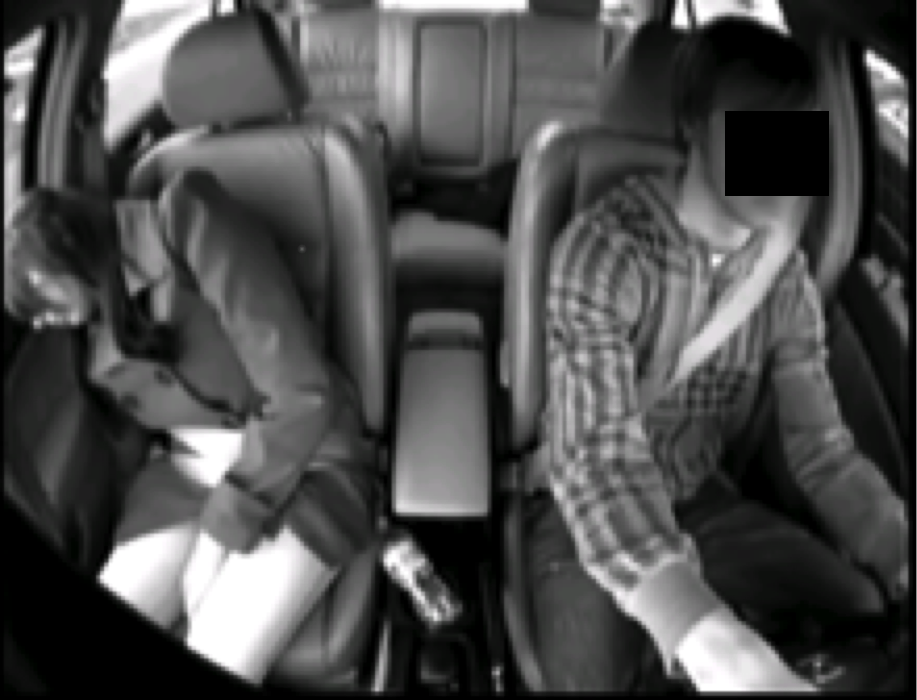
In trying to forecast how passengers in future vehicles will behave, we believe the best approach is to look at the activities of passengers in current vehicles. Surprisingly, passenger behaviors have not been studied extensively. Building on methods we used recently to study driver upper-extremity activities, we are coding videos from on-road trips with front-seat passengers from a previous naturalistic driving study. In 2019, we will gather additional data through video recorders installed in volunteers' vehicles. We anticipate that this data will provide baseline information on the distribution of activities in today's vehicles, which can be used not only to improve the design of current vehicles but also generate ideas for new interior concepts.
Motion Sickness
One of the biggest barriers to realizing the vision of cars as mobile workspaces and entertainment centers is motion sickness. A large percentage of the population experiences motion-sickness sensations when they are passengers in cars and light trucks. If this problem is not effectively addressed, many people will probably prefer to drive, since few people get sick as drivers. My colleague Dr. Monica Jones isleading a series of studies addressing this important challenge. Starting with data collection on the Mcity test track, she has moved onto the roads and highways around Ann Arbor to study the manner and rate at which motion sickness accrues. The data convincingly show that motion sickness is a multi-factorial experience, and not just nausea. The rate of increase in sensations is strongly affected by the vehicle acceleration domain and greatly exacerbated by the performance of a screen-based secondary task (in this case, reading on a tablet). One of the most important findings is that recovery from motion sickness above a certain level does not occur during travel; the person needs to be stopped for a relatively long time (~20 minutes) to recover to baseline. Many questions remain to be resolved about the etiology of motion sickness in vehicles. A surprising number of people seem to think this is a solved problem. In fact, no validated interventions or countermeasures short of "don't read" or "drive with less acceleration" have appeared in the literature. Nonetheless, the high rate of research and patent activitiy in this area indicates to us that people working with automated vehicle technology have realized that this is a very important barrier to adoption. Our work is ongoing -- contact Dr. Jonesfor more information.
Crash Safety for Occupants of Future Automated Vehicles
My colleague Dr. Kathy Klinich has looked at the likely distribution of crashes for vehicles that are themselves unlikely to cause a crash due to advanced technology. We've found that during the long phase-in period for crash-avoidance technology, occupants of highly automated vehicle will still experience crashes, although with a different distribution of types and severities. We have several efforts underway to gain the knowledge and develop the tools needed to improve safety for occupants exposed to these crashes.* Importantly, all of this knowledge will also be valuable for improving protection for passengers in current vehicles.*
One important line of research relates to the consequences of abrupt crash-avoidance manuevers, such as hard braking. Ideally, the crash avoidance maneuver will be successful, but sometimes a crash will still occur. Previous studies from our lab and others have shown that pre-crash braking or abrupt lane changes can substantially alter passenger posture away from the typical postures used for restraint system optimization. We are currently analyzing data from a recent study examining whether these motions differ across vehicles for similar events. In summer 2019, we will be conducting another large-scale test-track study gathering more data on passenger responses with different starting postures.
We are also underway with computational modeling of these pre-crash occupant motions. In a NHTSA-funded study led by Dr. Jingwen Hu, we are modifying the GHBMC simplified midsize-male model to respond dynamically to perturbations in the ~1g range. We anticipate that the model will be capable of realistic response to a wide range of horizontal perturbations. We will use our human volunteer data to tune and validate the model.
Crash Protection in Reclined Postures
We have recently kicked off a large-scale, collaborative effort to conduct basic biomechanics research addressing protection for reclined passengers. Preliminary modeling studies from our lab and others have shown that belt restraints can perform poorly for reclined passengers in frontal impacts, and the kinematics and loading of passengers in severe rear impacts also creates protection challenging. First, however, we need to gain sufficient understanding of occupant response in these conditions that we can accurately simulate these conditions with both computational and physical models (i.e., crash test dummies). In collaboration with the Medical College of Wisconsin, we are conducting a large-scale sled-test series with post-mortem human subjects focused on gathering response data across a wide range of recline and restraint conditions. Scheduled to continue into 2020, this program will yield highly valuable data that will be critical for developing advanced protection systems for occupants of future vehicles.