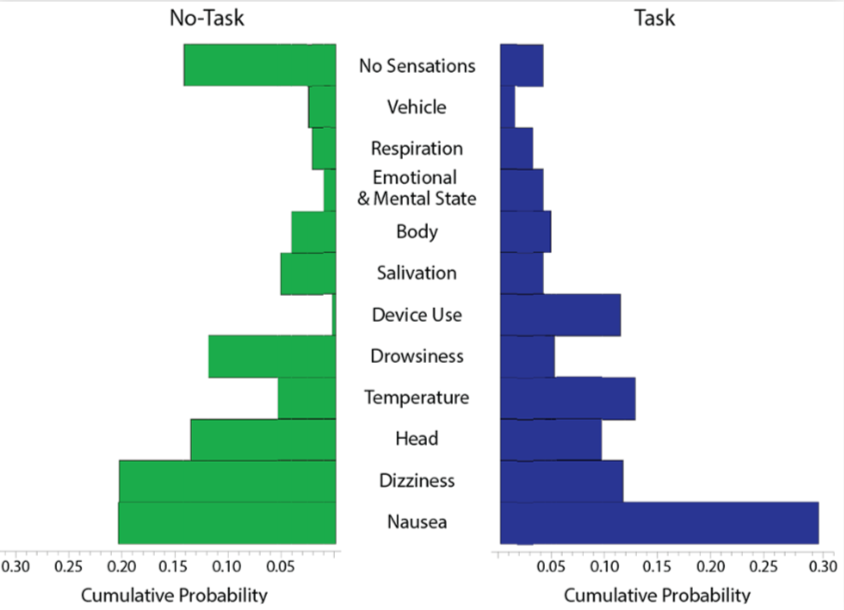
Our group was well-represented at the SAE Congress in April. My colleage Dr Monica Jones presented a paper on sensations reported by participants in a study on vehicle motion sickness she conducted. Motion sickness is an increasing concern due to the fact that passengers are much more susceptible to motion sickness than drivers are. As vehicle automation increasingly changes drivers into passengers, motion sickness can be expected to increase. Solutions are needed that can enable people to take advantage of the potential benefits of automation.
My colleage Dr Daniel Park presented preliminary results from a study examining road lane markings in the context of automated-vehicle sensing systems. Nearly all AV systems currently being tested on-road, as well as driver-assistance systems using similar technologies, rely on detecting lane markings. In this study, Dr Park's team is using a vehicle equipped with lidar and a high-resolution optical camera to monitor the detectability of lane markings on a nearby highway. This project is being conducted in conjunction with the Michigan Department of Transportation, who arranged to have a section of US-23 marked with four different types of paint. Tracking the performance of these materials over time will provide DOTs with useful information on how lane markings can facilitate the adoption of driver-assistance systems (particularly lane-keeping) and future vehicles with higher levels of automation.
I presented an overview of head and neck postures in highly reclined passenger seating scenarios. The head restraints in current vehicles are designed to reduce the risk of soft-tissue neck injury in rear impacts, rather than being designed to comfortably support the head in reclined postures. If future vehicles are to provide passengers with safe, comfortable rides in resting postures, improvements in seat design will be needed. These results, based on our recent study of reclined passenger postures, provide some useful guidance.