My colleague Dr. Jingwen Hu and I attended the 2019 ESV Conference in Eindhoven this month. Compared with the last ESV conference in 2017, this conference featured a great deal more realism about the challenges of vehicle automation and confronting the reality of mixed fleets in the coming decades. Among the realities is that advances in driver assistance systems will continue to move the safety goalposts for automation, reducing the potential benefits.
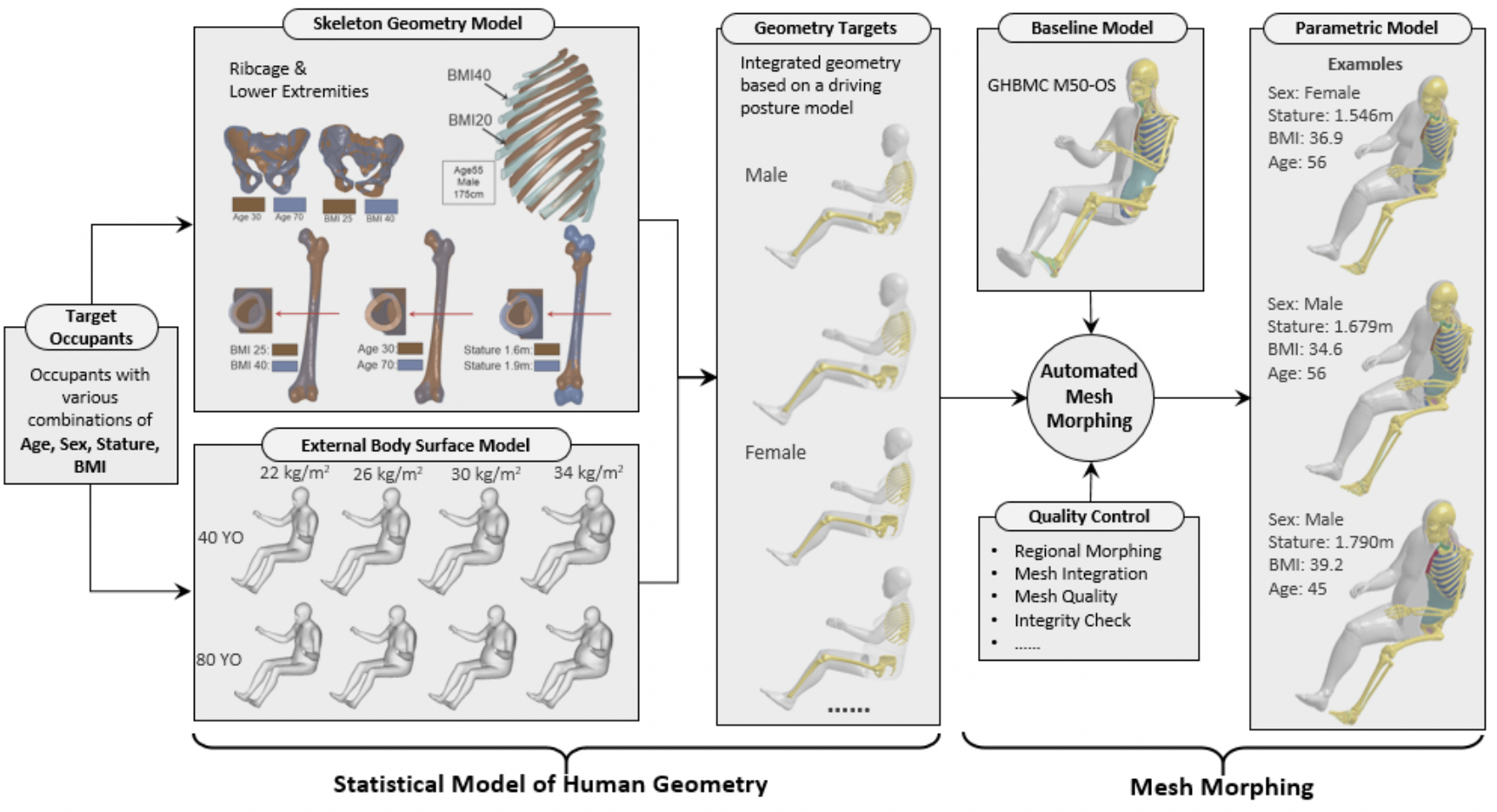
Dr. Hu presentedan overview over our most comprehensive effort to date to use our parametric human body modeling methodology to study the effects of driver characteristics on crash injury. From field data, we know that most occupants are at higher risk in crashes than the young midsize males best represented by the most widely used crash test dummies. In the study presented at ESV and published in Traffic Injury Prevention, Dr. Hu's team generated 50 male and 50 female human body models representing a large percentage of the US adult population with respect to stature, body weight, and age. This is an order of magnitude larger number of finite-element human body models previously generated in a single study. To do this work, we needed to develop fully automated methods to morph and posture the FE models within the simulated vehicle. We used validated driver posture prediction models, also a first in this domain.
The results showed large differences in safety in frontal impact depending on body size and shape. This line of research has the potential to guide the development of adaptive restraints that can provide people with a wide range of body size and shape with a similar level of protection in crashes.
I presented an overview of our recent research on reclined postures. In this talk, I focused on changes in belt fit associated with recline. On average the lap portion of the belt moved rearward relative to the pelvis as the participants reclined from back angles of 23 to 53 degrees. Because the pelvis is also rolling rearward with recline, this change in belt fit may make it more difficult to properly restraint the pelvis during a crash. We simulated a seat-integrated restraint in this study, moving the upper anchorage 1:1 with the seat back. However, the torso portion of the belt at the height of the claviclemoved closer to the midline with increasing recline. This probably doesn't represent a change in safety but may decrease comfort.