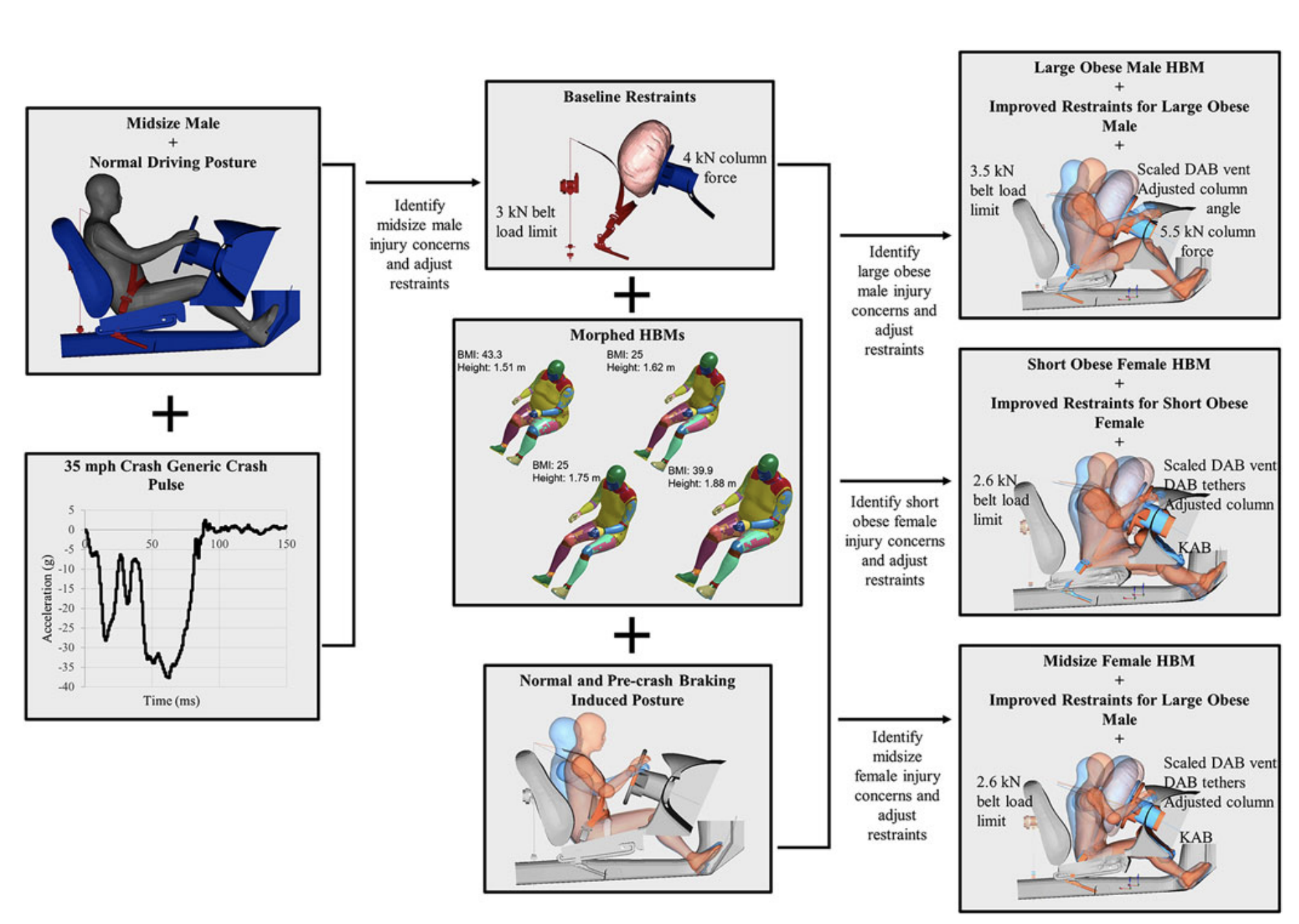
Our human modeling team, led by Dr. Jingwen Hu, published another paper documenting our application of parametric human body modeling to improving vehicle occupant restraint systems. This is the first analysis of the effects of pre-crash driving posture to take into account variability in both stature and BMI. It's also the first paper we're aware of to conduct human body model simulations with a midsize-female occupant. (Most prior work has used only a so-called "5th-percentile female" occupant that is very small for a driver in the US.) The simulation results demonstrated that body size and shape have larger influences on frontal crash outcomes than pre-crash posture over the ranges studied. The two obese models experienced higher levels of lower-extremity injury risk, consistent with results from the field. Now that more than 40% of US adults have BMI > 30, continuing to optimize restraints for crash test dummies that represent occupants with BMI < 25 is increasingly unrealistic. Parametric human body modeling allows a wide range of occupant sizes and shapes to be generated quickly so that restraint systems can be optimized for more realistic occupant populations.
January 2021
Optimizing Restraints for Populations