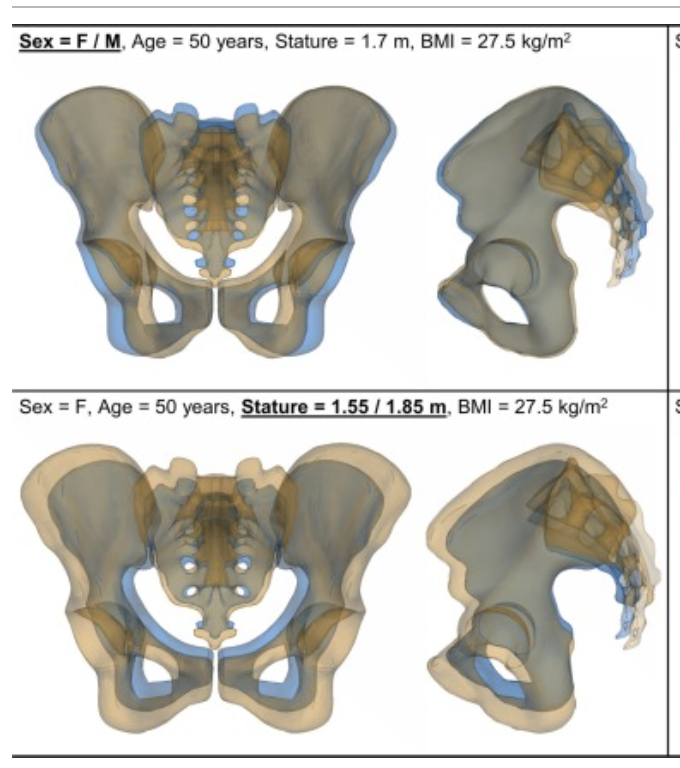
Erik Brynskog, a PhD student at Chalmers University in Sweden, has just published what is currently the best-available statistical model of pevis geometry. Using a dataset of geometry extracted from CT studies that was originally developed by Katelyn Klein and other UMTRI researchers, Erik digitized a much larger landmark set, enabling a considerably higher-resolution model of the pelvis. He also used a sparse PCA method in place of the conventional PCA, which will allow him to study local variability in pelvis shape more directly. Expect to see much more from Erik as he publishes the local shape analysis and considers how pelvis variability may affect restraint interaction and injury risk.
September 2021
Pelvis Bone Shape Modeling