A few updates on some of many projects my colleagues and I are currently working on:
Female Body Armor Fit
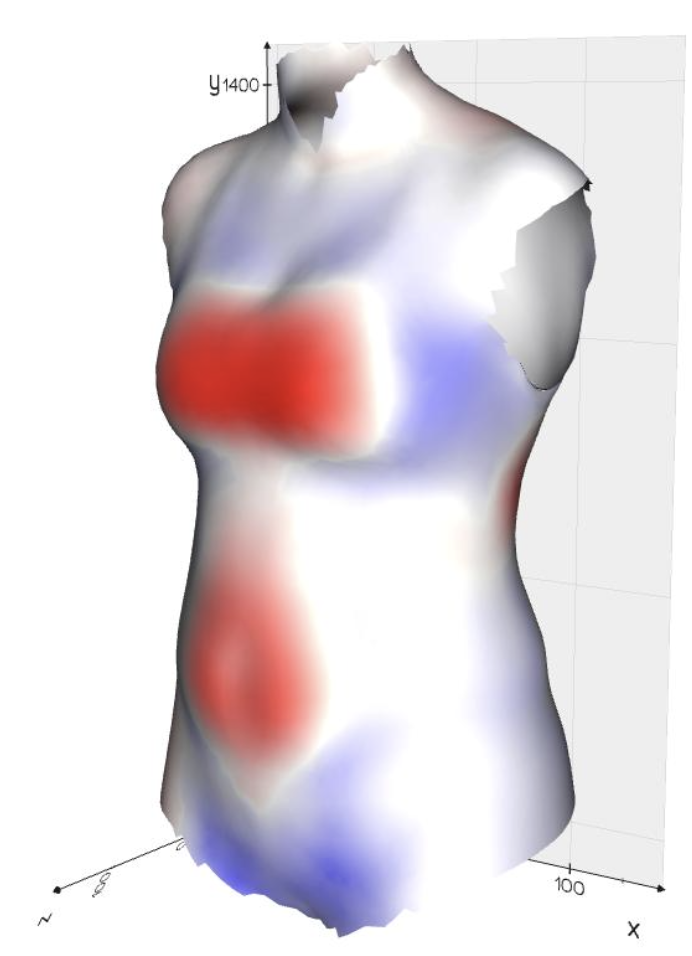
We're wrapping up a study for the U.S. Army Natick Soldier Center looking at issues related to body armor for female warfighters. In spite of a couple of decades (at least) of attention to the issue, complaints from the field indicate that body armor systems still don't work well for some women. In reviewing the literature, we found that minimal knowledge was available on the basics of the interaction between the torso and the body armor, so we focused our attention on developing methods to quantify that. This Phase-1 project included a laboratory study using 3D laser scanning and careful posture control to create the first-ever statistical model of torso deformation under body armor. We also developed a parametric finite-element modeling framework capable of simulating torso/plate interactions accurately.
We're wrapping up a study for the U.S. Army Natick Soldier Center looking at issues related to body armor for female warfighters. In spite of a couple of decades (at least) of attention to the issue, complaints from the field indicate that body armor systems still don't work well for some women. In reviewing the literature, we found that minimal knowledge was available on the basics of the interaction between the torso and the body armor, so we focused our attention on developing methods to quantify that. This Phase-1 project included a laboratory study using 3D laser scanning and careful posture control to create the first-ever statistical model of torso deformation under body armor. We also developed a parametric finite-element modeling framework capable of simulating torso/plate interactions accurately.
Ear Geometry Modeling
The shape of the human ear is of increased interest due to the importance of spatial audio for virtual reality applications. A person's ear and head shapes alter the way the sound reaches the ear drum on each side of the head, enabling people to very accurately locate the direction and distance of sounds. The head-related transfer function (HRTF) or equivalently the Head-Related Impulse Response (HRIR) describe quantitatively the ways that a particular person's anatomy affects the sounds reaching their eardrums. Knowledge of a each person's anatomy is needed to provide them accurate spatial audio through binaural headphones. Prior work on quantifying the variability in human ear shapes has focused primarily on point-to-point dimensions on the pinna (external ear) and to a lesser extent on outer ear canal geometry based on molding techniques that have been used for decades to create custom hearing aids and other in-ear devices. Drawing on our expertise in medical imaging data, we have created a new best-in-class model of ear geometry that incorporates the head, scalp, pinna, as well as the entire ear canal to the ear drum. The new model, based on data from hundreds of people, will provide an unprecedented ability to design audio experiences for the entire spectrum of head and ear shapes. We hope to integrate the new ear model into our head model to create new audio design tools.