We have been exceptionally busy even by our normally crazy standards. But we're fortunate to be able to do studies that will have major impact in future years.
Children Climbing on Dressers (Clothing Storage Units): Tip-Over Injuries
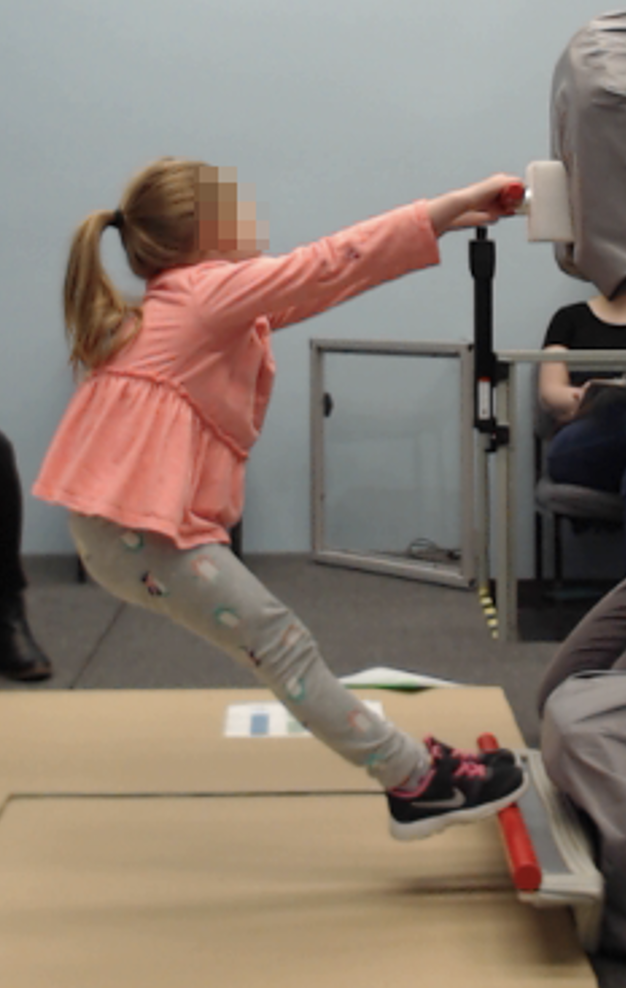
Thousands of young children every year in the U.S. are injured when a dresser they are interacting with (usually climbing on them) tips over. Beginning in 2019, the U.S. Consumer Product Safety Commission funded a study in our group to quantify, for the first time, the forces children exert when climbing. We designed a laboratory study and recorded force and posture data for 40 children ages 2 to 6 interacting with our lab fixtures in various naturalistic ways. The results of the study were cited in the development of a new regulation for clothing storage units that the CPSC issued in the fall of 2022. As these things go, the industry sued and lobbied Congress to force CPSC to instead adopt a much weaker, industry written ASTM standard. But the overall story is still a success: clothing storage units (dressers) will be safer under the new mandatory standard than under the earlier voluntary standard. Moreover, our research highlights the reality that children can easily exert forces on furniture that greatly exceed the values in the standard. Our report on this work appeared in the Federal Register in 2022 and is now available at U-M.
Ear Geometry Modeling for Audo and Other Applications
The technical report on our recent ear geometry modeling effort is now available online. Prior studies have used primarily landmark-to-landmark measurements rather than a three-dimensional analysis. We extracted 331 ears from CT studies of 224 people and developed a high-resolution statistical shape model capable of highly expressive representation of a wide range of ear size, shape, and location. Principal component analysis demonstrated a large amount of variance not previously quantified in the position and orientation of the ears with respect to the skull. A regression analysis confirmed previous findings of sex differences in the increase of ear size with increasing age and demonstrated an effect of body mass index on ear position and orientation that has not been previously described. A boundary method in principal component space was used to generate a set of ears suitable for designing devices for which the ear position on the head is important. Boundary ears were also generated in pinna-centered coordinates for applicability to in-ear device design, demonstrating the flexibility of the dataset and analysis methodology. To our knowledge, this study developed the largest and highest-resolution database of human ear geometry, the first to be measured in head-centered coordinates, and the first to include the geometry of the canal to the ear drum.