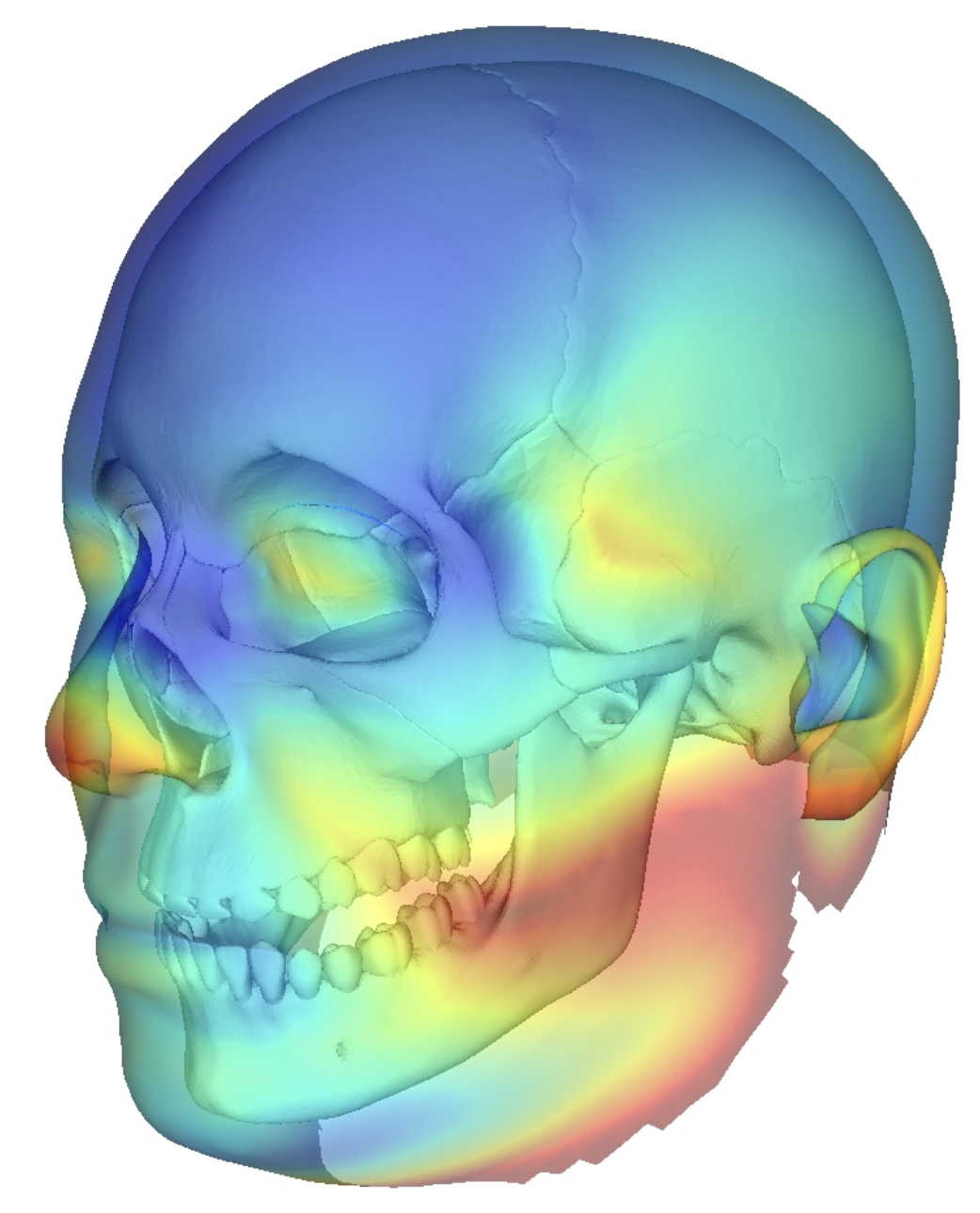
We continue to make progress on many areas of our research, including our YouthShape anthropometry survey of children ages 3-17 years (now over 550 children measured in 3D), child strength measurements (data over 800 children ages 9 months to 11 years now being analyzed), and statistical modeling of anatomical structures, including the spine, ribcage and head. The image to the right shows our new skull model. Based on 244 high-resolution CT studies (each extracted skull is over 1.5M polygons), the new parametric skull model allows us to predict with high accuracy the skull inside any head surface scan. Or vice-versa: we can predict head/face shape from the skull, a goal of many forensic analyses. Our primary application is generating a wide range of realistic heads to analyze things like oxygen mask fit for fighter pilots (a current project), VR headset fit (another current project), and concussion risk as a function of head and neck geometry. [In the image, the color scale reflects the flesh margin between the skin and the nearest point on the bone. The model accurately predicts the very thin flesh margins at the bridge of the nose and around the orbit.]
August 2024
Statistical Skull Shape Model Linked to Head Shape