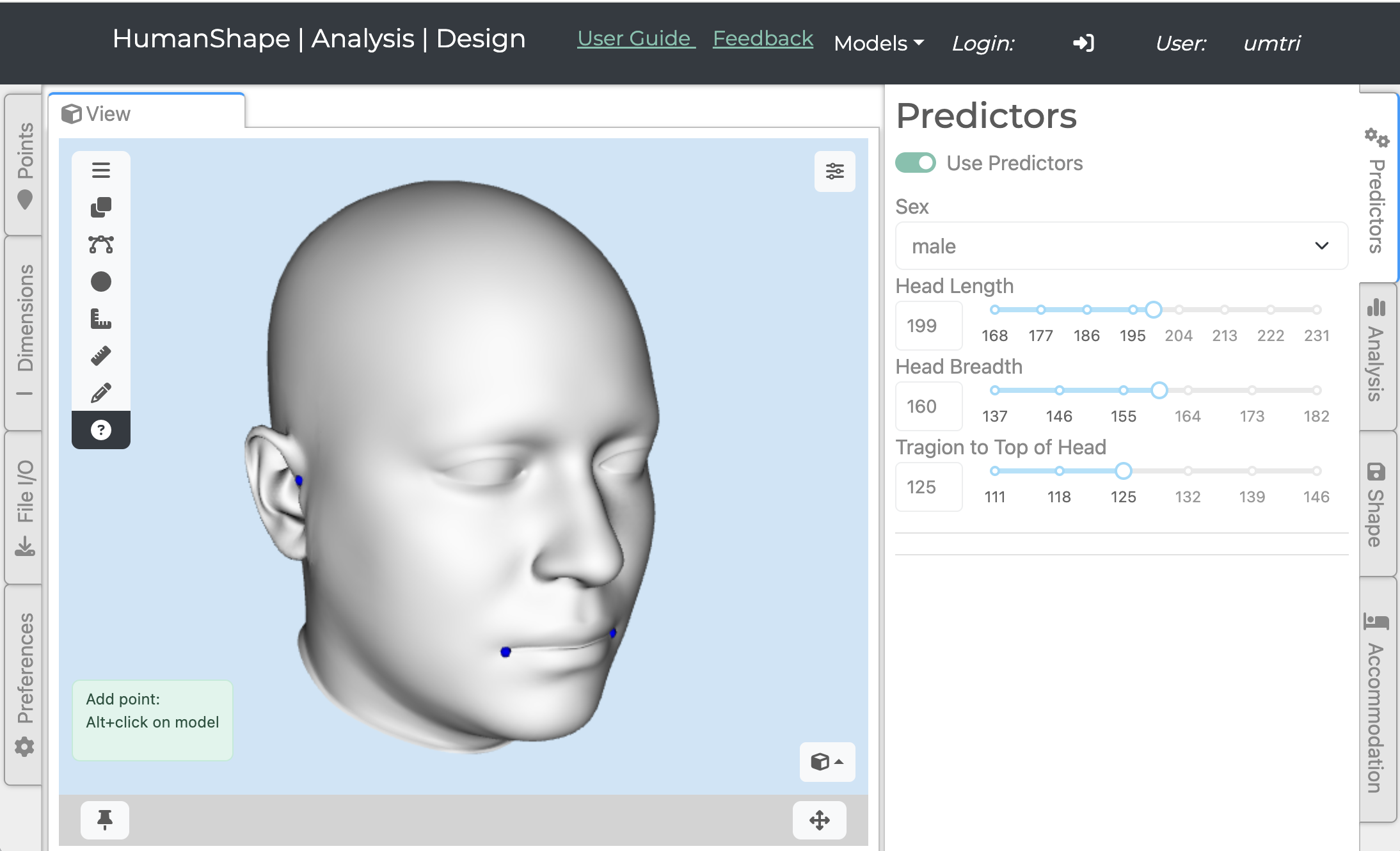
The application of human body measurement to design has been stuck in the 1950s since, well, the 1950s. Nearly all applications of anthropometric data to products still involve a designer or engineer looking up a 5th or 95th percentile value in the back of a book (now a PDF). The population is wrong, the data are out of date, and the measurement usually isn't the right one anyway. Almost every industrial design and engineering human factors program teaches anthropometry the same way, more than 30 years after widespread availability of desktop computers and 3d anthropometry. Why? Many reasons, including an anthropometry priesthood descended from physical anthropologists very committed to high-precision manual measurement within "allowable error", but fundamentally the problem has been a lack of computation. As long as the only means of disseminating data was/is a table of pre-calculated univariate quantiles on variables selected before the design variables are known, whether in a book or on a computer screen, nothing more can be done. For example, the vast majority of applications of 3d anthropometric surveys has been to distill the 3d data to the same univariate statistics previously computed from manually measured data, essentially discarding nearly all of the information.
I am making it my primary mission in the peak years of my career to try to do something to improve this situation. The primary solutions have been known since the 1950s: it is necessary to use data representing the target population to conduct simultaneous multivariate analysis, ideally with** 3d data in relevant postures.** But this requires (1) rich datasets, (2) the ability to weight or synthesize data to representation the target population, and (3) powerful computational tools. Computerized solutions to multivariate accommodation analysis have been proposed since the mid-1970s, yet are still vanishingly rare in practice.
And all of this must be tied into domain-specific practices. The tools needed for automotive interior design are different from those needed for designing XR headsets. What's common across domains is the humans, and rich, accurate human data is where we start. Stay tuned for much more on our progress.