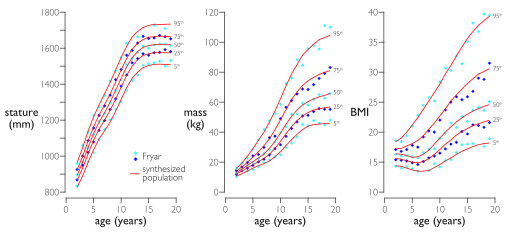
My colleague Matt Parkinson and I have just published a paper that supports our efforts to improve the quality of anthropometric data for children. The most representative data for U.S. children are gathered and published through the ongoing National Health and Nutrition Examination Survey. The anthropometric measures are only a small part of the survey, but the rigorous sampling methodology tied to the U.S. Census surveys makes these data the best available for quantifying the body size of U.S. children by sex, age, and race/ethnicity. There are challenges in using these data, however: any analyses must incorporate the sample weights (each sampled child represents a different number of children in the population as a whole) and the sample is fairly small, meaning that quantile estimates based on single-year bins vary unrealistically. We addressed these issues by synthesizing a large, unweighted dataset of stature and BMI by age and sex. The new dataset allows direct, unweighted calculations and provides smoother quantiles across age and better precision for tail quantile estimates. Most importantly, this new dataset will provide a foundation for generating nationally representative outcomes from the YouthShape.US survey.
March 2026
Generating Representative Pediatric Populations