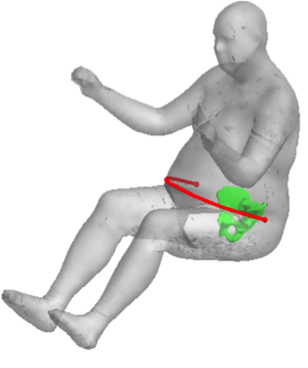
I presented a short communication at the IRCOBI annual conference in Lyon, France. A substantial part of our current research focuses on measuring and modeling body shape. Many of our applications relate to automobile crash safety. Using whole body scan data, we analyzed the contour of the lower abdomen in the area where the lap portion of a three-point belt is routed. We found that the length of this contour is strongly associated with body mass index (BMI), which is a useful surrogate for adiposity. Age had a small effect, but gender was unimportant. This research is consistent with our previously published work showing that high BMI is associated with relatively poor lap belt fit. That is, high-BMI individuals tend to place the belt higher and more forward relative to the pelvis. The current study confirms that the effect can be largely accounted for by lower abdomen protrusion, a finding that is not unexpected, but is now quantitatively demonstrated. We have previously published human simulation studies demonstrating the consequences of high BMI for drivers, which are consistent with our analysis of field crash data. We are currently underway with studies to evaluate the effectiveness of advanced belt systems and other countermeasures to improve restraint performance for the 1/3 of U.S. adults who are obese.
November 2013
IRCOBI Conference: Abdomen Contours and Belt Fit