My colleagues Kathy Klinich and Lauren Zaseck and I participated this month in the annual conference of the International Research Council on the Biomechanics of Injury (IRCOBI) held this year in beautiful Málaga, Spain. We presented and co-authored several papers this year.
Dr. Zaseck presented this innovative simulation study examining the consequence of rib fractures on thorax response. PMHS often have rib fractures due to CPR. Typically such specimens are rejected for biomechanics testing involving the thorax due to concerns that the response would be strongly affected. This simulation study suggests that a small number of rib fractures is unlikely to have a large effect, which also opens the door to more efficient use of PMHS through multiple impacts.
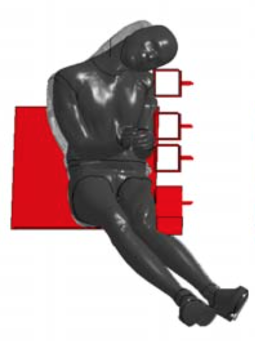
My colleague Dr. Martínez from INSIA in Madrid presented the results of assembling components from range of crash test dummies to better represent the size and mass distribution of individuals with OI. This work is an important step toward developing improved occupant protection systems for this population.
I presented this work by my post-doc Dr. Jangwoon Park, the latest in a long series of papers on belt fit in vehicle seats for occupants with a wide range of characteristics. The results were similar to those presented previously for drivers, showing a strong effect of BMI on belt fit. Individuals with high BMI tend to have markedly worse lap belt fit than those with normal BMI, potentially reducing safety in frontal and other collisions. The findings confirm the need to look for new ways of improve belt fit and belt performance for all occupants, particularly those who are not shaped like crash test dummies.
My colleague Dr. Klinich presented this innovative study looking at the potential consequences of advanced crash avoidance systems and vehicle lightweighting. Even if a vehicle cannot cause a crash, other vehicles will still collide with it and cause risks to the occupants. Our analysis of current crash data suggests that side impacts will become increasingly important as frontal impacts are reduced and mitigated. This effect is accentuated by vehicle lightweighting, which exposes the occupants to higher accelerations.
I presented this short communication presenting the development of a geometric target for the pelvis of a small-female crash test dummy. Current small-female ATDs have pelves developed by simple geometric scaling of midsize-male pelves. This analysis, which is based on Katelyn Klein's PhD work, demonstrates that linear scaling produces a distinctly unrealistic pelvis shape. We've made the results of this work available online.