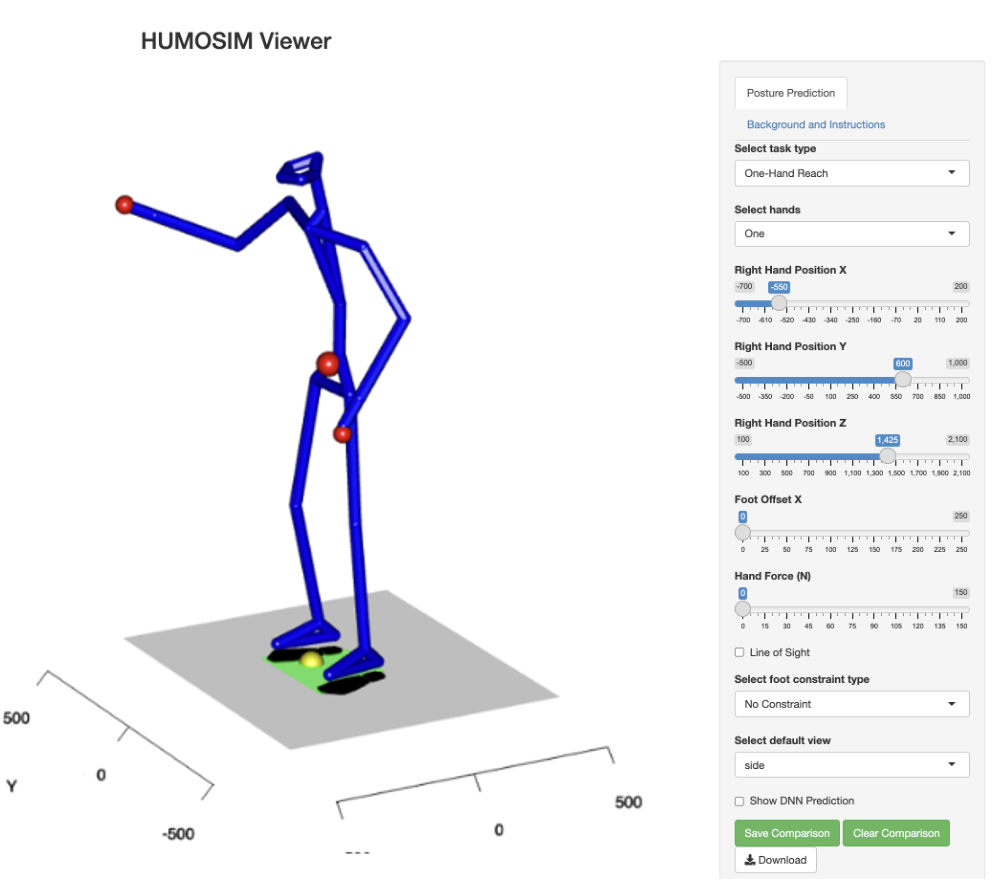
At the Human Factors and Ergonomics Society annual meeting this month, I presented a paper in an occupational ergonomics sesssion on some playing around I've been doing with machine learning and large posture datasets. This paper gives an overview of a deep neural net regression model that predicts standing task postures from anthropometry and task parameters (hand locations with respect to the feet, hand forces, and a few other variables). The data were gathered in two large-scale studies led by my colleagues Dr. Monica Jones and Dr. Clive D'Souza. The DNN models were fit inR using the Keras library. What's more interesting is that I have created an online demo with downloadable output. The demo was written in R using Shiny. The implementation of a prediction model like this in human modeling software used for ergonomics analysis is critical, because the predictions are never quite consistent with the physical requirements of the task. The Humosim Framework approach uses inverse kinematics and optimization to match the predictions as well as possible while also respecting the kinematics constraints and maintaining balance. This proof-of-concept could lead to more useful implementations, in part through incorporation of more data. The extension to motion is straightforward; we have 10s of thousands of motions in our database that could be used for training.
October 2022
Deep-Neural Nets for Posture Prediction at HFES